A few weeks ago I asked myself a simple question: is my own site actually any good?
Not "is the code clean" — I can measure that. But: does a tradesperson landing from Google immediately understand what I offer? Do they trust it? Do they take action?
I couldn't ask contacts to "look at my site" every time I made a change. So I did what I probably should have done from the start: I built a tool.
1. Why I built this tool
I'm a developer. When I have a recurring problem, my natural reflex is to automate it. This project — which I call Echo — is a good example of vibe coding: I had a clear need, I prototyped fast, I iterated.
The starting idea was simple. I wanted to simulate "realistic" visitors on my site — not generic bots that scan HTML, but personas with a profile, an arrival channel, a device, a decision maturity level. Visitors with a story who react the way a real potential client would.
The tool generates these personas, simulates their journeys, and produces a structured report: who converts, who hesitates, who leaves — and above all, why.
In plain terms: Echo sends AI visitors to your site. Each one has a precise profile — age, profession, device, arrival channel, budget — and reports back what they thought, what convinced them, what blocked them.
Once I'd built and tested the tool on my own sites, I decided to offer it to others. Not because it's a finished, polished product — it's still handcrafted, clearly — but because the insights I get from it are useful, and I think others could benefit too.
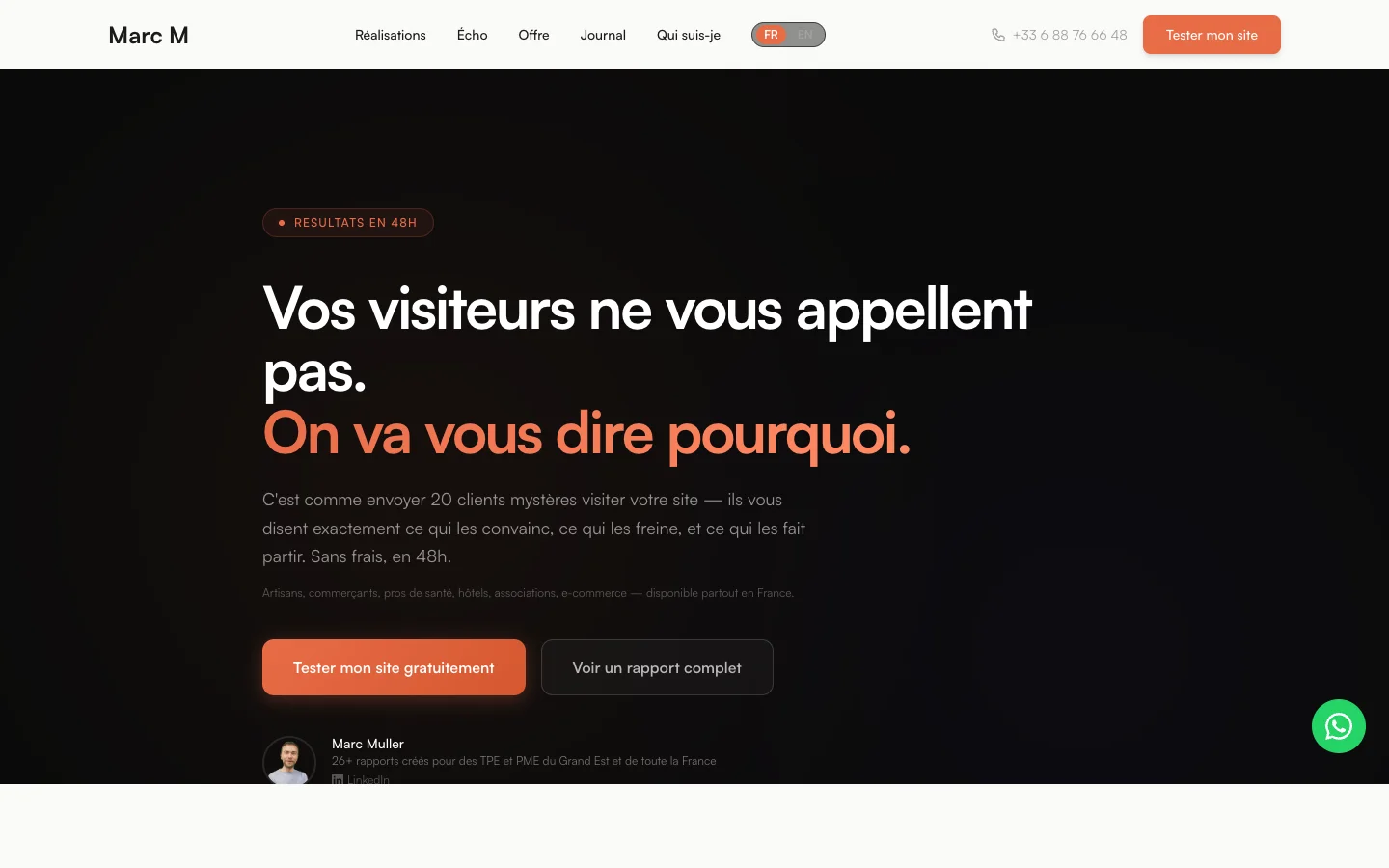
The Echo page on marcm.fr — 3 plans, from free to €250
2. How Echo works
You give me your site URL. The tool generates a batch of personas and simulates their visits. Each persona has a detailed profile:
Who they are
Age, profession, situation, location, estimated budget
How they arrive
Google Search, Google Maps, word of mouth, social media, AI (ChatGPT…) — on mobile, desktop or tablet
Where they are in their decision
Discovery (curious), Comparison (evaluating options), Decision (ready to act)
What they take away
Their page-by-page journey, key question, what convinced them, what blocked them, final decision
The output is a structured report: overall conversion rate, breakdown by channel and decision maturity, scores for experience / trust / clarity, list of identified friction points, and the 3 priority actions to improve.
The report is a dedicated web page, readable on mobile, that you can share. Not a 40-page PDF no one reads to the end.
3. What I discovered about marcm.fr
I ran the Pro version (100 visitors) on my own site. Here's what came back.
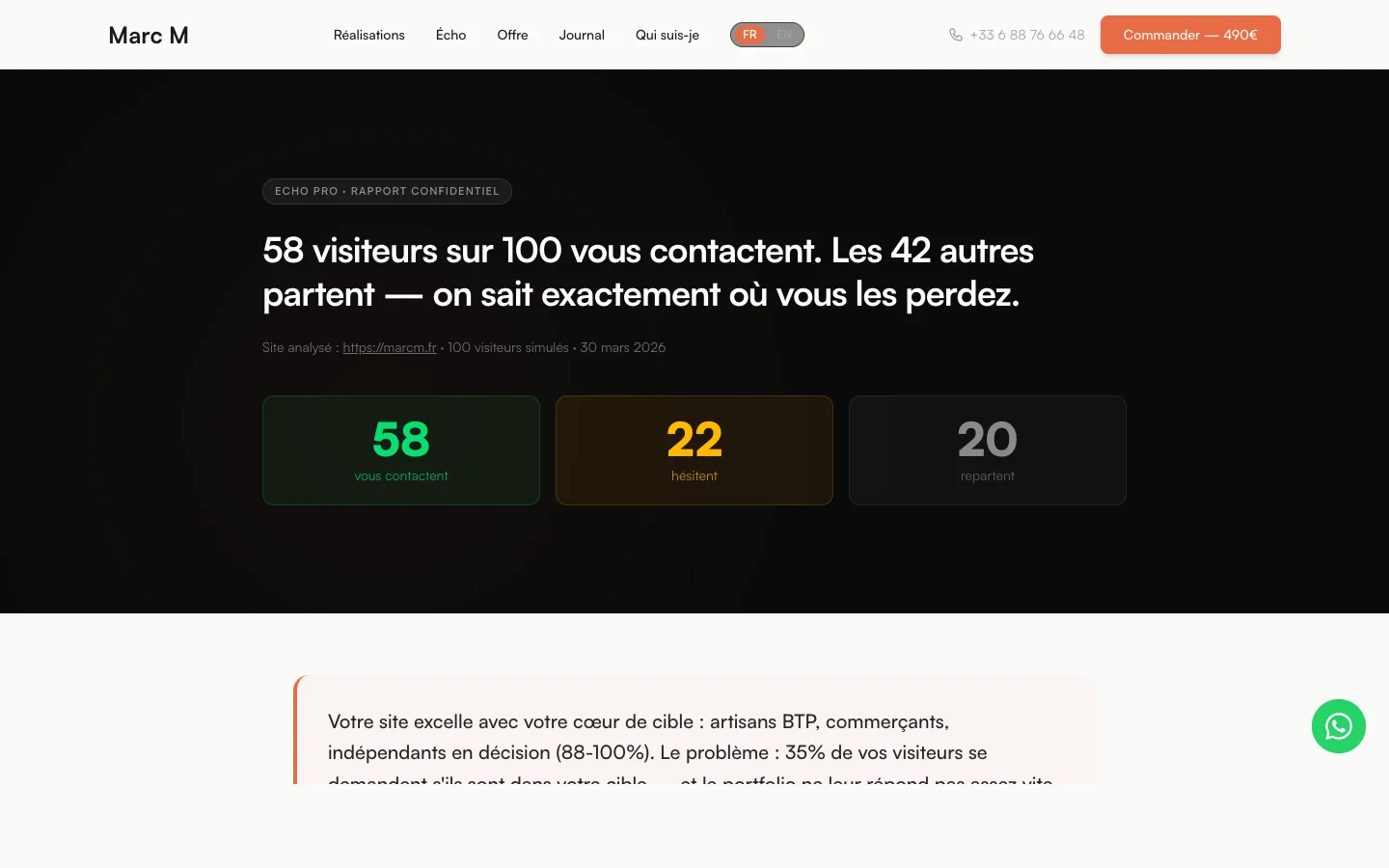
Echo Pro report for marcm.fr — view the full report
58
contact
22
hesitate
20
leave
58 out of 100 visitors get in touch — which is pretty solid. But the real value was understanding why the other 42 leave or hesitate.
Not all acquisition channels are equal
| Channel | Contact rate |
|---|---|
| Word of mouth | 90% |
| Google Maps / GBP | 80% |
| AI (ChatGPT, Claude…) | 67% |
| Google Search | 62% |
| Social media | 25% |
The social media result at 25% stood out immediately. People arriving from Instagram or LinkedIn come without context, without clear intent — and the site doesn't warm them up fast enough. That's a friction point I wouldn't have identified on my own.
The main friction: a portfolio that isn't sector-diverse enough
35% of visitors weren't sure they were the right audience. The portfolio covers tradespeople and local businesses well, but not freelance professionals, healthcare practitioners, or service providers who need booking systems. These visitors hesitate or leave because they don't see themselves reflected in the work shown.
That's not a criticism I would have guessed intuitively. It's exactly the kind of insight that only surfaces when you look at your site from the outside.
6.7/10
Experience
7.0/10
Trust
7.1/10
Clarity
Decent scores, but not excellent. Room to improve — and now I know exactly where to act.
4. Available plans
Discovery
5 simulated visitors
A quick snapshot — the single priority recommendation that would most improve your conversion rate. Ideal for testing the tool before going further.
Complete
20 simulated visitors + technical audit
Interactive report with breakdown by channel, device, and profile. Friction points identified, actions ranked by impact.
Pro
100 simulated visitors + 30-min consultation
The version I ran on my own site. Full analysis: channels, decision maturity, cross-matrix, advanced breakdowns. Plus a call to debrief together.
5. Try it on your site
Echo is still young. I consider it a well-functioning beta — useful, but I'm still learning what makes it most valuable depending on the type of site.
What I'm looking for now is concrete feedback: do the friction points identified match your gut feeling? Are the personas realistic for your sector? Is the report readable and actionable?
If you have a site — portfolio, shop, landing page, service site — and you want a structured external perspective, the Discovery plan is free. No commitment, results within 48 hours.
What you get with the Discovery plan (free):
- ✓ 5 simulated visitors on your site
- ✓ Estimated conversion rate
- ✓ The #1 recommendation to improve
- ✓ Report delivered within 48h

Marc Muller
Freelance web developer. I build fast, lightweight websites for tradespeople and small businesses across France, delivered in 5–10 days, no WordPress, no heavy maintenance.
Further reading
Try Echo on your site
The Discovery plan is free — 5 simulated visitors, the priority recommendation, results within 48h.
I'm looking for real-world feedback: tell me if the report matches what you already suspected.
See Echo — free Discovery plan